


Strada Reale Corner with Strada San Giovanni
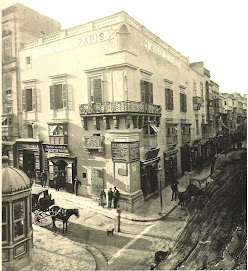
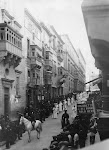
PICTURES 1 AND 2 Photo taken pre 1896, most probably even before. The total absence of telegraph and telephone lines which crisscrossed the upper levels of Valletta buildings suggest this approximate date. Also of note are the gas light columns typical of the period, while the lamp overlying the third doorway from the left of Strada Reale would be fuelled by oil, and denotes a private entrance. The building itself does not present any inspiring features. It is from the renaissance period, and from the earliest typical constructions in Valletta. Evident changes are the construction of the wooden balconies (gallariji) abutting from the (ex) windows of the first floor. These could probably have been added in the late 1700’s when many Valletta facades were refurbished to include baroque features, and the inclusion of wooden balconies was in vogue. Also, the open balcony on the second floor was constructed at a different period from other works. The different designs of stone legs (saljaturi) of the gallariji & balcony are most evident. A problem arises when trying to identify the main entrance to the building. The obvious assumption would put it in Strada Reale as it would put it in the most prestigious street, but not necessarily in this case. An entrance from St John’s street, facing St John’s cathedral would have also been a prestigious alternative for this site. A search through Victor Denaro’s “ houses of Valletta”, proved fruitless as there is no mention whatsoever of the building in either St. John’s Street or Strada Reale. A further search in the British sanitary plan of Valletta of the 1900 brings further confusion, as sanitary fittings are marked for each doorway, denoting that the shops must have had closets in their basements. The British water situation plan of 1864, based on Romano Carapecchia’s (1666-1738) assessment, shows an inlet and outlet for water on the St. John Street side to doors 2 and 3 from the corner of Strada Reale. For the size of the building, a minimum of 2 water cisterns would be available. The plan shows a direct feeder from door no. 3 to the public cistern across the road; and also that the house cisterns themselves overspilled into each other, before the surplus water returning to the public one. All this suggests that the entrance would have been in St John’s street. By the standards of the time, door 1 would have been a direct entrance to the cellar and door 2 to a stable. As there is little doubt that the overlying stories were owned by Bartoli Galea as a residence, the direct entrance in this case must be through door 3,- the shop owned by the Bartoli Galeas. The entrances from Strada Reale would have been servants entrance, stores and kitchen, and sometimes a workshop. First floor would have the bedrooms and and dining room. The latter would have attached to it a small pantry itself connected with the kitchen, directly below by an internal staircase.
The top floor would house the main bedrooms and the Sala Nobile. This was a large hall, usually 40-50 feet long formally decked out to welcome visitors and entertain. An informal and smaller living room would be on the first floor. Any servants living on the premises would usually be housed in
small rooms going up to the rooftop. Strange is the total absence of chimneys. It was usual for the kitchen to have a cooking galley, whilst the hall would have a fireplace. This sometimes was connected with another in a bedroom directly below. Finally, another point of interest is that the block of apartments adjacent to the building on the Strada Reale side has not yet been constructed, and one can view the original building. PICTURES 3 AND 4: This photo was taken on 19th April 1903 during the visit of King Edward VII. Our concerns for this picture are twofold –
1. That Saverina Bartoli Galea has by this time taken over the hair Cutting salon of Francis la Porta.
Clearly seen are the wares on offer in the shop-windows - Hats, embroidered goods and a child size Mannequin completely outfitted. Unfortunately we are not able to see if the first doorway has also been taken over.
2. The appearance of electric light in the form of globes overlying the shop-windows.
PICTURES 5 AND 6: The photo shows Strada Reale decorated for the coronation of George V in June 1911. While we cannot distinguish if the corner door on St. John’s street has yet been taken over, we are able to note, however, that on the Strada Reale side the previous shops and wooden balconies are still there. PICTURES 7 AND 8: This is a first copy from An Illustrated Guide to the Islands of Malta and Gozo (1914-1919), Malta, Critiens. I have been fortunate to be granted permission by the owner to make a copy of this, and another important picture advertisement of another establishment some years ago. Clearly, Bartoli Galea has taken over all the shops on both sides. Symmetry of the building is assured by the removal of the wooden balconies. Ironically, we can now enjoy the view of the upper stories as (nearly) originally built during the Knights period.
The ground floor is now presented as a continuous shop front on both sides. The workmanship in wood and the design is very similar to other shops of the period, still post Edwardian, with the most significant being LANCELLOTTI in Strada Mezzodi and JOSEPH FORMOSA in Strada Reale. The style is heavy and filling but still elegant to look at. The thin lines running across the upper part of the photo are not scratches but are rather the telegraph and telephone wires which are missing in the first picture. Also one can now see that the apartments on the Strada Reale side have been constructed. This, unfortunately, was one of the early scars inflicted during a period when mass housing and not beauty, in Valletta was a priority. NOTES FOR POST WWII PERIOD I have not had the opportunity to view pictures of the site when it was destroyed. It was the same stick of bombs that destroyed the Opera house, the Ellis premises right opposite and Auberge de Auvergne that did the job. I have however had the opportunity to interview people whom unfortunately are now deceased and who remembered the site well, one of these being my grandfather. Bartoli Galea closed down before WWII. On the Strada Reale side there were instead a pharmacy -The Colonial pharmacy and the Dominion Library, who were also printers in the same premises. The site had been divided further and small apartments formed part of the complex. After the war, the site was sold to become The National Bank. Many figures have been mentioned, But the most affidable have informed me that the sum of ten thousand Sterling is the most reliable. Still, I stand to be corrected. A FINAL NOTE ON THE PRESENT BUILDING The Knights obliged the owners of buildings to be constructed to adhere to a strict code of rules, the most significant being a supply of water. The size and quantity of cisterns to be constructed was based on the number of persons residing in the building or the size of the site itself. Most probably there were at least 3 large bell shape wells dug. The average size would be a height of 20 ft with a diameter of 30 ft, giving an approximate area of 150 cubic metres of space. It is difficult to determine how many and how much. There are existing examples of wells in Valletta houses that resemble more a cube-like quarry than a well. In any case, all this would be at a depth reachable from the cellar floor which brings us to some 3 stories below street level. I would not be at all surprised that the present basement, vaults and lift wells of the bank are housed in what were once water cisterns.
Joseph Piccinino July 2009
PICTURES 1 AND 2 Photo taken pre 1896, most probably even before. The total absence of telegraph and telephone lines which crisscrossed the upper levels of Valletta buildings suggest this approximate date. Also of note are the gas light columns typical of the period, while the lamp overlying the third doorway from the left of Strada Reale would be fuelled by oil, and denotes a private entrance. The building itself does not present any inspiring features. It is from the renaissance period, and from the earliest typical constructions in Valletta. Evident changes are the construction of the wooden balconies (gallariji) abutting from the (ex) windows of the first floor. These could probably have been added in the late 1700’s when many Valletta facades were refurbished to include baroque features, and the inclusion of wooden balconies was in vogue. Also, the open balcony on the second floor was constructed at a different period from other works. The different designs of stone legs (saljaturi) of the gallariji & balcony are most evident. A problem arises when trying to identify the main entrance to the building. The obvious assumption would put it in Strada Reale as it would put it in the most prestigious street, but not necessarily in this case. An entrance from St John’s street, facing St John’s cathedral would have also been a prestigious alternative for this site. A search through Victor Denaro’s “ houses of Valletta”, proved fruitless as there is no mention whatsoever of the building in either St. John’s Street or Strada Reale. A further search in the British sanitary plan of Valletta of the 1900 brings further confusion, as sanitary fittings are marked for each doorway, denoting that the shops must have had closets in their basements. The British water situation plan of 1864, based on Romano Carapecchia’s (1666-1738) assessment, shows an inlet and outlet for water on the St. John Street side to doors 2 and 3 from the corner of Strada Reale. For the size of the building, a minimum of 2 water cisterns would be available. The plan shows a direct feeder from door no. 3 to the public cistern across the road; and also that the house cisterns themselves overspilled into each other, before the surplus water returning to the public one. All this suggests that the entrance would have been in St John’s street. By the standards of the time, door 1 would have been a direct entrance to the cellar and door 2 to a stable. As there is little doubt that the overlying stories were owned by Bartoli Galea as a residence, the direct entrance in this case must be through door 3,- the shop owned by the Bartoli Galeas. The entrances from Strada Reale would have been servants entrance, stores and kitchen, and sometimes a workshop. First floor would have the bedrooms and and dining room. The latter would have attached to it a small pantry itself connected with the kitchen, directly below by an internal staircase.
The top floor would house the main bedrooms and the Sala Nobile. This was a large hall, usually 40-50 feet long formally decked out to welcome visitors and entertain. An informal and smaller living room would be on the first floor. Any servants living on the premises would usually be housed in
small rooms going up to the rooftop. Strange is the total absence of chimneys. It was usual for the kitchen to have a cooking galley, whilst the hall would have a fireplace. This sometimes was connected with another in a bedroom directly below. Finally, another point of interest is that the block of apartments adjacent to the building on the Strada Reale side has not yet been constructed, and one can view the original building. PICTURES 3 AND 4: This photo was taken on 19th April 1903 during the visit of King Edward VII. Our concerns for this picture are twofold –
1. That Saverina Bartoli Galea has by this time taken over the hair Cutting salon of Francis la Porta.
Clearly seen are the wares on offer in the shop-windows - Hats, embroidered goods and a child size Mannequin completely outfitted. Unfortunately we are not able to see if the first doorway has also been taken over.
2. The appearance of electric light in the form of globes overlying the shop-windows.
PICTURES 5 AND 6: The photo shows Strada Reale decorated for the coronation of George V in June 1911. While we cannot distinguish if the corner door on St. John’s street has yet been taken over, we are able to note, however, that on the Strada Reale side the previous shops and wooden balconies are still there. PICTURES 7 AND 8: This is a first copy from An Illustrated Guide to the Islands of Malta and Gozo (1914-1919), Malta, Critiens. I have been fortunate to be granted permission by the owner to make a copy of this, and another important picture advertisement of another establishment some years ago. Clearly, Bartoli Galea has taken over all the shops on both sides. Symmetry of the building is assured by the removal of the wooden balconies. Ironically, we can now enjoy the view of the upper stories as (nearly) originally built during the Knights period.
The ground floor is now presented as a continuous shop front on both sides. The workmanship in wood and the design is very similar to other shops of the period, still post Edwardian, with the most significant being LANCELLOTTI in Strada Mezzodi and JOSEPH FORMOSA in Strada Reale. The style is heavy and filling but still elegant to look at. The thin lines running across the upper part of the photo are not scratches but are rather the telegraph and telephone wires which are missing in the first picture. Also one can now see that the apartments on the Strada Reale side have been constructed. This, unfortunately, was one of the early scars inflicted during a period when mass housing and not beauty, in Valletta was a priority. NOTES FOR POST WWII PERIOD I have not had the opportunity to view pictures of the site when it was destroyed. It was the same stick of bombs that destroyed the Opera house, the Ellis premises right opposite and Auberge de Auvergne that did the job. I have however had the opportunity to interview people whom unfortunately are now deceased and who remembered the site well, one of these being my grandfather. Bartoli Galea closed down before WWII. On the Strada Reale side there were instead a pharmacy -The Colonial pharmacy and the Dominion Library, who were also printers in the same premises. The site had been divided further and small apartments formed part of the complex. After the war, the site was sold to become The National Bank. Many figures have been mentioned, But the most affidable have informed me that the sum of ten thousand Sterling is the most reliable. Still, I stand to be corrected. A FINAL NOTE ON THE PRESENT BUILDING The Knights obliged the owners of buildings to be constructed to adhere to a strict code of rules, the most significant being a supply of water. The size and quantity of cisterns to be constructed was based on the number of persons residing in the building or the size of the site itself. Most probably there were at least 3 large bell shape wells dug. The average size would be a height of 20 ft with a diameter of 30 ft, giving an approximate area of 150 cubic metres of space. It is difficult to determine how many and how much. There are existing examples of wells in Valletta houses that resemble more a cube-like quarry than a well. In any case, all this would be at a depth reachable from the cellar floor which brings us to some 3 stories below street level. I would not be at all surprised that the present basement, vaults and lift wells of the bank are housed in what were once water cisterns.
Joseph Piccinino July 2009


No comments:
Post a Comment